


The moment a potential customer lands on your website, the journey has already been underway for a while. They've asked Google a question. They've scanned a few stars on a review platform. They've probably checked what strangers said before deciding whether to walk through your door virtual or otherwise. By the time they arrive, they've already made up their minds about you. The question is: were you there when they were making it?
This is the reality of the modern buyer journey, a path that no longer follows a straight line from awareness to consideration to purchase. Instead, today's consumers move across an average of 2.4 platforms before committing to a decision. They might start with a Google search, drift to an industry-specific review site, linger on a brand's social media presence, and circle back to a second search all before filling out a contact form or clicking "buy." Understanding this fragmented, multi-platform journey has become one of the most important strategic challenges facing marketers in 2026.
What Is the 2.4-Platform Buyer Journey?
The 2.4-platform buyer journey describes the modern consumer's research behavior: before making a purchase decision, the average person consults approximately two to three different digital platforms to gather information, verify claims, and build trust. This isn't just a casual browse. Research shows that consumers spend an average of 13 minutes and 45 seconds reading reviews before they decide to trust a local business. That's nearly fourteen minutes of concentrated attention, spread across multiple touchpoints, as buyers convince themselves that they're making the right choice.
The term "2.4 platforms" reflects a statistical reality captured in current research on consumer behavior. According to data from WiserReview's 2026 analysis of online review statistics, consumers now use an average of six review sites during their research process a number that has increased from previous years. The broader 2.4-platform figure encompasses not just review sites but the full ecosystem of search engines, social media, brand websites, and peer recommendations that buyers navigate before converting.
The journey is non-linear and often unconscious. A buyer might discover a product through a TikTok video, verify it on Google, check the Better Business Bureau, read Reddit discussions, and return to the brand's Instagram for a final look. What appears to be randomness follows predictable patterns and the businesses that map those patterns gain a significant advantage.
Why 2.4 Platforms? The Psychology Behind Multi-Platform Research
Trust doesn't happen in a vacuum. The human brain is wired to seek confirmation from multiple sources before committing to a decision especially a decision that involves money. When a potential customer sees a business mentioned positively in one place, it registers as a data point. When that same business appears credible across two or three platforms, the data points multiply and reinforce each other. The buyer begins to feel certainty rather than doubt.
Research confirms this behavior at scale. According to Capital One Shopping's 2026 analysis of online review influence, more than 99% of American consumers read online reviews before making purchases, and reviews influence 93% of consumers' purchasing decisions. These aren't marginal numbers they represent near-universal behavior. The average consumer isn't deciding whether to read reviews; they're deciding which reviews to read and where to find them.
The 2.4-platform average emerges from this multiplication of sources. When 97% of consumers read online reviews of a local business before visiting, and 71% of shoppers begin their consumer research with Google reviews, and 84% of consumers search for positive online reviews before making an in-store purchase, the overlapping layers create a complex but navigable landscape. Each platform serves a different function in the buyer's decision-making process: Google for discovery, industry review sites for validation, social media for character assessment, and peer networks for social proof.
The Key Stages of the 2.4-Platform Buyer Journey
While every buyer follows a slightly different path, the 2.4-platform journey typically moves through four recognizable stages. Understanding these stages allows businesses to identify where they appear or where they vanish.
Stage One: Problem Recognition and Initial Search
The journey begins when a buyer realizes they have a need. This triggers an immediate move to a search engine most often Google. Data from Capital One Shopping indicates that 71% of shoppers begin their consumer research with Google reviews, making the search giant the de facto starting point for the majority of purchase journeys. At this stage, the buyer isn't yet committed to a brand or even a category. They're casting a wide net, looking for possibilities.
For businesses, this stage demands visibility in organic search results and local listings. If your business doesn't appear when someone searches for the category you serve, you don't exist at the beginning of the journey. The buyer moves on, and following them becomes significantly harder.
Stage Two: Platform Hopping and Information Gathering
Once a buyer identifies potential options, they begin what researchers call "platform hopping" moving across multiple sites to compare, cross-reference, and verify. This is where the 2.4-platform average becomes most visible. According to Synup's comprehensive 2026 review statistics, 74% of consumers refer to at least two review sites before making purchasing decisions. WiserReview's data shows that 91.1% of consumers typically read at least one review before purchasing a product, with 54.7% reading at least four reviews. The buyer is building a case, and they're building it across multiple platforms simultaneously.
What are they looking for? According to Dixa's research on customer review influence, consumers want the nitty-gritty details the experiences and problems customers have had, how businesses responded to complaints, consensus on whether products or services lived up to claims. They're not just checking for five-star ratings. They're reading between the lines, looking for authenticity, and using what they find to predict their own future experience.
"79% of customers put as much weight on customer reviews as they do personal recommendations." Dixa's Research on Customer Review Influence
Stage Three: Trust Building and Risk Reduction
By the third stage, the buyer has gathered significant information and is now working to reduce perceived risk. This is where consistency across platforms becomes critical. When a business presents one story on its website, another on Google, a third on Yelp, and yet another on social media, the inconsistency raises red flags. The buyer interprets the mismatch as a sign that something is wrong that the business isn't reliable, transparent, or perhaps even legitimate.
Capital One Shopping's data reveals that 49% of consumers place as much trust in online reviews as they do in personal recommendations, and among 18- to 34-year-olds, this share increases to 91%. For younger demographics especially, the consensus of online strangers has become equivalent to word-of-mouth from friends. Trust is no longer built through a single platform or a single message it's built through the cumulative weight of consistent, credible presence across multiple touchpoints.
Interestingly, the data also shows that consumers have become more discerning about the reviews themselves. According to Capital One Shopping, 76% of consumers are more likely to trust that reviews are genuine when they are mixed as opposed to only five-star reviews. A perfect score can actually reduce credibility. Buyers have learned to be skeptical, and businesses that appear too polished risk looking manufactured.
Stage Four: Final Verification and Conversion
The final stage is where the buyer makes their move but the decision has already been made in the previous stages. What happens at conversion is largely a formality, though the experience must not break the trust that was carefully built. The first five reviews have the highest impact on conversion rates, according to research cited in Capital One Shopping's analysis. The velocity and recency of reviews matter as much as their quantity.
Research from WiserReview found that 20% of consumers only read reviews written within the previous two weeks. A business with hundreds of reviews from years past may actually perform worse than one with fewer but more recent reviews. The buyer wants to know that the business being reviewed is the same business they would experience today.
Who Created the 2.4-Platform Buyer Journey Framework?
The 2.4-platform buyer journey framework emerges from the synthesis of multiple research streams rather than a single creator. The underlying data comes from annual surveys conducted by organizations like BrightLocal, research published by the Northwestern Spiegel Research Center, and analysis by firms including WiserReview, Capital One Shopping, Synup, and Dixa. These organizations collectively track how consumers behave across digital platforms, and their combined findings form the empirical foundation for understanding multi-platform buyer behavior.
The specific figure of "2.4 platforms" reflects a rounding of detailed statistical findings. While individual sources report higher numbers for review-site usage specifically six sites on average, per WiserReview's 2026 data the broader buyer journey encompasses a wider range of digital touchpoints including search engines, brand websites, social media, and peer communication. The 2.4 figure represents the typical diversity of platform types a buyer engages during their decision process.
This framework builds on decades of customer journey mapping but adds a critical new dimension: the acknowledgment that today's buyers don't follow a single path but instead create their own individualized routes through the digital landscape. Rather than forcing buyers through a marketer-designed funnel, the 2.4-platform framework meets buyers where they already are and works backward to identify the touchpoints that matter most.
How B2B Buyers Navigate Multiple Platforms During Their Purchase Journey
The multi-platform journey isn't limited to consumer purchases. B2B buyers follow similar patterns, though the stakes are often higher and the timelines longer. Corporate Visions' 2026 analysis of B2B buying behavior identifies significant shifts in how business buyers research and evaluate vendors. While B2B purchases may involve more stakeholders and longer consideration periods, the underlying research behavior remains consistent: buyers gather information across multiple platforms, verify claims through independent sources, and build trust through accumulated evidence.
The difference in B2B often lies in the specific platforms and the depth of review required. A business buyer might spend hours reading case studies on a vendor's website, cross-reference those claims on LinkedIn, check peer recommendations in industry forums, and verify the company's reputation on professional review platforms. The 2.4-platform journey in B2B is less about the number of platforms and more about the thoroughness of investigation at each stop.
What the data makes clear is that no single touchpoint can carry the full weight of building buyer trust. A business website with excellent copy and compelling offers cannot compensate for poor reviews on third-party platforms. A strong social media presence cannot overcome an absence of search visibility. The 2.4-platform journey reveals that trust is distributed it must be built, maintained, and consistently reinforced across every platform where a buyer might look.
How Businesses Can Optimize Their Marketing for the 2.4-Platform Journey
Understanding the 2.4-platform journey is only the first step. The second and more challenging step is applying that understanding to marketing strategy. Here is where many businesses struggle. The instinct is often to double down on a single platform that seems to be working, to pour resources into the channel that currently drives the most traffic. But the 2.4-platform framework suggests that this approach is counterproductive. The goal is not to dominate one platform but to be present, credible, and consistent across multiple platforms simultaneously.
Map Your Current Platform Presence
Before optimizing, businesses must understand where they currently appear in the buyer journey. Start by identifying every platform where your business has a presence search engines, review sites, social media channels, industry directories, and any other digital touchpoints. Then assess the quality and consistency of that presence. Is your business name, address, and phone number consistent across every platform? Are your hours, services, and descriptions up to date? Do you have recent reviews on each platform, and have you responded to them?
According to WiserReview's data, only about 5% of businesses respond to their online reviews. This represents an enormous opportunity. Businesses that engage with their reviewers both positive and negative signal to future buyers that they are active, responsive, and committed to customer experience. The act of responding itself becomes a form of marketing, visible to everyone who reads the review.
Prioritize Platforms Based on Buyer Research Patterns
Not all platforms carry equal weight in the 2.4-platform journey. Research shows that Google hosts around 73% of all online reviews, making it the dominant platform, according to WiserReview's 2026 analysis. This doesn't mean businesses should ignore other platforms the entire point of the 2.4-platform framework is that buyers span multiple sites but it does suggest where to start. Google presence should be the foundation of any multi-platform strategy, with other platforms built around it rather than the other way around.
Beyond Google, the specific platforms that matter most depend on your industry and your customers. A restaurant might prioritize Yelp and OpenTable alongside Google. A B2B software company might focus on G2, Capterra, and LinkedIn. A local service business might concentrate on Google, Angi, and Facebook. The key is to identify where your buyers are looking and ensure you have a credible presence there.
Create Consistent Messaging Across Every Touchpoint
Consistency is the thread that connects the 2.4-platform journey. When a buyer moves from Google to a review site to a social media profile, they should encounter the same business the same values, the same voice, the same offerings. Any discrepancy erodes trust. According to Dixa's research, consumers want to see reviews on products and services, but they also look for nitty-gritty details about experiences, complaints, and responses. The business that tells a consistent story across platforms gives buyers the confidence to proceed.
Consistency doesn't mean duplication. A business's Google listing should not be an exact copy of its Facebook page or its website's About section. Instead, the core facts should align name, address, phone number, hours, core services while the tone, depth, and specific content can vary by platform. The buyer should never feel that they've landed on a different business because the details don't match.
Focus on Review Velocity and Recency
The 2.4-platform journey rewards businesses that generate reviews consistently over time. Research from Capital One Shopping shows that the first five reviews have the highest impact on conversion rates. This means that for new businesses or businesses entering new markets, the initial burst of reviews carries disproportionate weight. But the data from WiserReview also shows that 20% of consumers only read reviews written within the previous two weeks, meaning ongoing review generation is equally important for established businesses.
The solution is a systematic approach to review generation. According to Capital One Shopping's 2026 data, 81% of consumers are most likely to leave reviews for businesses that go above and beyond to provide an exceptional experience. This means the foundation of review generation is delivering exceptional service but businesses can also make the process easier by directing satisfied customers to the appropriate platforms with clear, simple instructions.
The Business Impact: What the Numbers Say About Optimizing for the 2.4-Platform Journey
The case for optimizing around the 2.4-platform journey isn't theoretical it's measurable. Multiple studies have quantified the impact of review presence on conversion rates and revenue. According to Capital One Shopping's analysis, studies show that displaying customer reviews can boost sales by 19.8%. Reviews from verified buyers increase conversion by 15%. And the impact is even more dramatic at scale: conversion rates increase by 76.7% when retailers display online product reviews, and by at least 143% when over 100 reviews are displayed.
Dixa's research adds additional context, finding that on average, reviews produce an 18% uplift in sales. This figure aligns closely with Capital One Shopping's findings, suggesting that the actual impact falls somewhere in the high teens to low twenties as a percentage of baseline sales. For many businesses, an 18% to 20% increase in sales without a corresponding increase in traffic or marketing spend represents a significant improvement in return on investment.
The impact varies by category and price point. Capital One Shopping's data shows that conversion rate increases are more dramatic for luxury items (380%) than for low-priced items (190%) when retailers display reviews. This doesn't mean review optimization matters less for affordable products it means the relative impact scales with the decision weight of the purchase. But across all categories, the presence of reviews increases buyer confidence and reduces the friction that prevents conversions.
Why Buyers Use Multiple Platforms: The Trust Deficit and the Verification Instinct
The question of why buyers feel compelled to research across multiple platforms deserves deeper examination. The short answer is trust or more precisely, the lack of it. Modern consumers operate in a trust deficit environment where skepticism toward business claims has become the default posture. They've encountered fake reviews, misleading advertising, and broken promises too many times to take any single claim at face value.
Capital One Shopping's data reveals that 75% of shoppers who read online reviews are concerned about fakes. WiserReview estimates that approximately 30% of online reviews are fake. This creates a paradox: reviews are both the most trusted source of information and the source most likely to be manipulated. The buyer's response is to cross-reference to check multiple platforms and look for patterns of consistency that suggest authenticity.
This behavior is rational and adaptive. When 49% of consumers find online customer reviews very helpful when making purchasing decisions, and 85% of consumers are hesitant to consider a product without online reviews, the verification instinct makes perfect sense. Buyers aren't being difficult they're being thorough. The businesses that understand this and work to meet the verification instinct head-on are the ones that earn trust faster and convert more reliably.
The 2.4-platform journey is, at its core, a trust-building exercise. Each platform a buyer visits represents another opportunity to demonstrate credibility. Each consistent, authentic review adds weight to the cumulative case for your business. The goal of multi-platform marketing is not to be everywhere but to be genuinely and consistently present where it matters most to your buyers.
What This Means for Gartner, Search Engine Land Readers
For marketers and business owners reading this on Gartner, Search Engine Land, the 2.4-platform buyer journey has direct implications for how you allocate resources, measure performance, and structure your digital presence. The days of optimizing for a single channel are over. The modern buyer doesn't follow a single path, and your marketing shouldn't either.
Start by examining your current multi-platform footprint. Are you present on the platforms where your buyers begin their research and do you appear credible on each one? Are your business listings consistent across every directory and review site? When someone reads your Google reviews, then checks your Facebook page, then visits your website, do they encounter the same business? The answers to these questions will reveal gaps in your 2.4-platform strategy that you can begin to close.
The data is clear: the businesses that invest in consistent, multi-platform presence outperform those that concentrate resources on a single channel. With 99% of consumers reading reviews before purchasing and the average buyer spanning 2.4 platforms during their decision process, the margin for absence is thin. If you're not there when a buyer checks, a competitor will be.
Where to Read Further
For additional data on how online reviews shape consumer behavior in 2026, explore the following resources:
- Capital One Shopping's 2026 Online Review Statistics comprehensive data on how reviews influence purchasing decisions, trust patterns, and conversion rates
- WiserReview's 77 Online Review Statistics for 2026 detailed breakdown of review site usage, consumer behavior trends, and platform-specific insights
- Synup's 100+ Updated Online Review Statistics extensive collection of review-related data points organized by impact and application
- Dixa's Research on Customer Review Influence analysis of how reviews function as trust signals and their measurable impact on sales
- Corporate Visions' B2B Buying Behavior Analysis for 2026 insights into how business buyers navigate the multi-platform journey in enterprise purchasing contexts
Summary: Key Data Points from the 2.4-Platform Buyer Journey
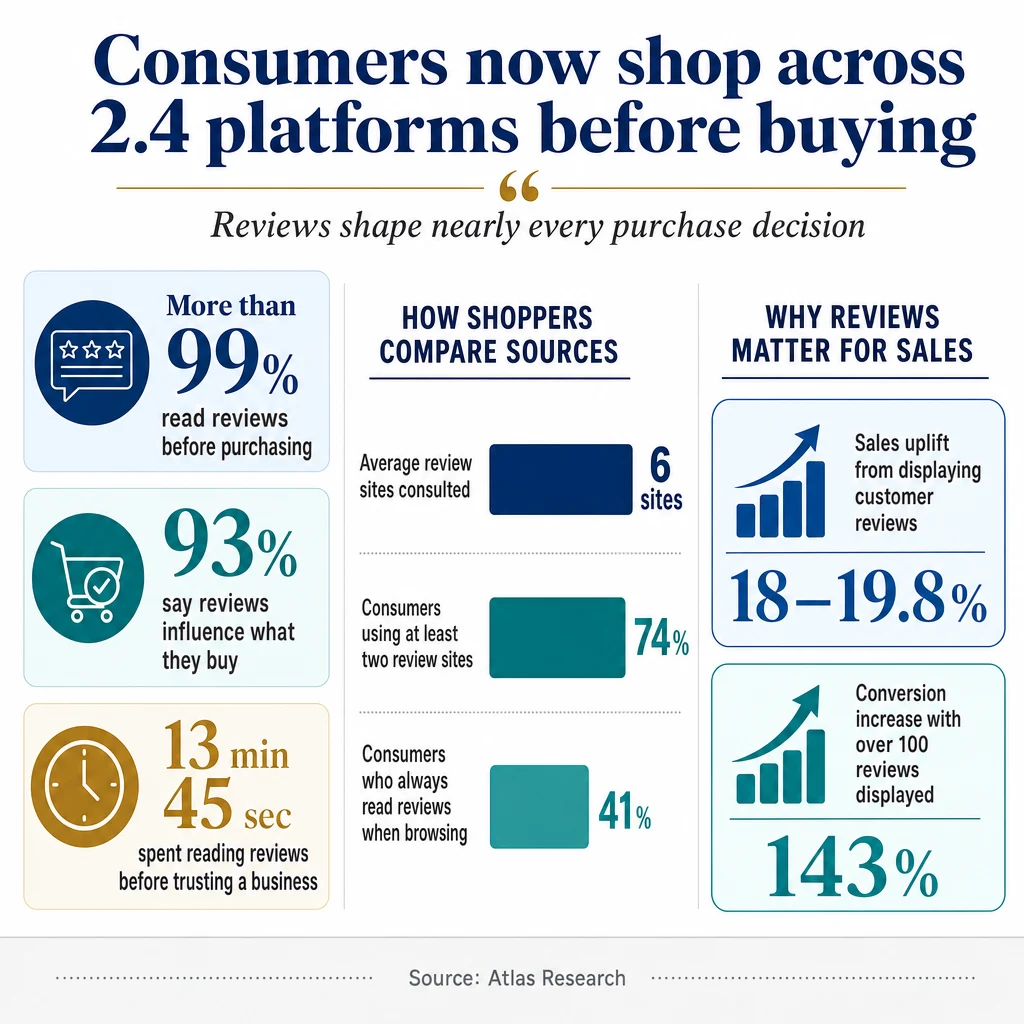
| Metric | Finding | Source |
|---|---|---|
| Consumers who read reviews before purchasing | More than 99% | Capital One Shopping, 2026 |
| Consumers whose purchasing decisions are influenced by reviews | 93% | Capital One Shopping, 2026 |
| Average time spent reading reviews before trusting a business | 13 minutes, 45 seconds | Capital One Shopping, 2026 |
| Average review sites consulted per purchase | 6 sites | WiserReview, 2026 |
| Consumers who refer to at least two review sites | 74% | Synup, 2026 |
| Sales uplift from displaying customer reviews | 18-19.8% | Dixa and Capital One Shopping |
| Conversion rate increase with over 100 reviews displayed | 143% | Capital One Shopping, 2026 |
| Consumers who always read reviews when browsing | 41% | WiserReview, 2026 |
| Consumers who trust reviews as much as personal recommendations | 49% | Capital One Shopping, 2026 |
| Share of online reviews estimated to be fake | 30% | WiserReview, 2026 |
FAQs: The 2.4-Platform Buyer Journey
What is the 2.4-platform buyer journey?
The 2.4-platform buyer journey describes the modern consumer's research behavior before making a purchase. On average, buyers consult approximately 2.4 different digital platforms such as search engines, review sites, social media, and brand websites to gather information, verify claims, and build trust before committing to a decision. This framework reflects the fragmented, multi-touch reality of contemporary purchasing behavior.
Who created the 2.4-platform buyer journey framework?
The framework emerges from the synthesis of multiple annual research surveys and studies, including those published by BrightLocal, the Northwestern Spiegel Research Center, WiserReview, Capital One Shopping, Synup, and Dixa. These organizations collectively track consumer behavior across digital platforms and publish annual findings that inform our understanding of multi-platform buyer behavior. The specific "2.4 platforms" figure reflects a rounding of detailed statistical data on the typical diversity of touchpoints buyers engage during their decision process.
Why do buyers use multiple platforms before making a purchase?
Buyers span multiple platforms primarily because of trust dynamics. Research shows that 75% of shoppers are concerned about fake reviews, and approximately 30% of online reviews are estimated to be fake. To reduce perceived risk, buyers cross-reference information across platforms, looking for patterns of consistency that suggest authenticity. The average buyer also spends nearly 14 minutes reading reviews before trusting a business, indicating that research is thorough rather than superficial.
How can businesses optimize their marketing for the 2.4-platform journey?
Optimization begins with mapping your current multi-platform presence and ensuring consistency across every touchpoint where your business appears. Key strategies include maintaining accurate, consistent business listings on major platforms (especially Google, which hosts 73% of all reviews), generating reviews consistently over time (since the first five reviews carry the highest conversion impact), responding to all reviews to signal active engagement, and ensuring that core facts about your business align across every platform a buyer might visit.
What impact do online reviews have on conversion rates?
The impact is significant. Studies show that displaying customer reviews can boost sales by approximately 19.8%, with reviews from verified buyers increasing conversion by 15%. Conversion rates increase by 76.7% when retailers display online product reviews and by at least 143% when over 100 reviews are displayed. The effect is more dramatic for luxury purchases (380% increase) than for low-priced items (190%), but reviews increase buyer confidence across all categories.